Subscribe Pages
- About
- How to change email providers
- Patents and papers about color
- Previsualization heresy
- Using in-camera histograms for ETTR
- 01. Acknowledgments
- 02. Why ETTR?
- 03. Normal in-camera histograms
- 04. Image processing for in-camera histograms
- 05. Making the in-camera histogram closely represent the raw histogram
- 06. Shortcuts to UniWB
- 07. Preparing for monitor-based UniWB
- 08. A one-step UniWB procedure
- 09. The math behind the one-step method
- 10. Iteration using Newton’s Method
- Who am I?
Links
-
Recent Posts
Recent Comments
Archives
- May 2013
- April 2013
- March 2013
- February 2013
- January 2013
- December 2012
- November 2012
- October 2012
- September 2012
- August 2012
- July 2012
- June 2012
- May 2012
- April 2012
- March 2012
- February 2012
- January 2012
- December 2011
- November 2011
- October 2011
- September 2011
- August 2011
- July 2011
- June 2011
- May 2011
- April 2011
- March 2011
- February 2011
- January 2011
- December 2010
- November 2010
- October 2010
- September 2010
- August 2010
- July 2010
- June 2010
- May 2010
- April 2010
- March 2010
- February 2010
- January 2010
- December 2009
- November 2009
- October 2009
- September 2009
- August 2009
- July 2009
- June 2009
- May 2009
- April 2009
- March 2009
- February 2009
- January 2009
- December 2008
- November 2008
- October 2008
- September 2008
- August 2008
- July 2008
- June 2008
- May 2008
- April 2008
- March 2008
- February 2008
- January 2008
- December 2007
- November 2007
- September 2007
- June 2007
- March 2007
- December 2006
- September 2006
- June 2006
- April 2006
- December 2005
- March 2005
- December 2004
- March 2004
- December 2003
- September 2003
- June 2003
- March 2003
- December 2002
- September 2002
- June 2002
Categories
Pages
- About
- How to change email providers
- Patents and papers about color
- Previsualization heresy
- Using in-camera histograms for ETTR
- 01. Acknowledgments
- 02. Why ETTR?
- 03. Normal in-camera histograms
- 04. Image processing for in-camera histograms
- 05. Making the in-camera histogram closely represent the raw histogram
- 06. Shortcuts to UniWB
- 07. Preparing for monitor-based UniWB
- 08. A one-step UniWB procedure
- 09. The math behind the one-step method
- 10. Iteration using Newton’s Method
- Who am I?
Monthly Archives: January 2011
Resampling for printing — basic alternatives
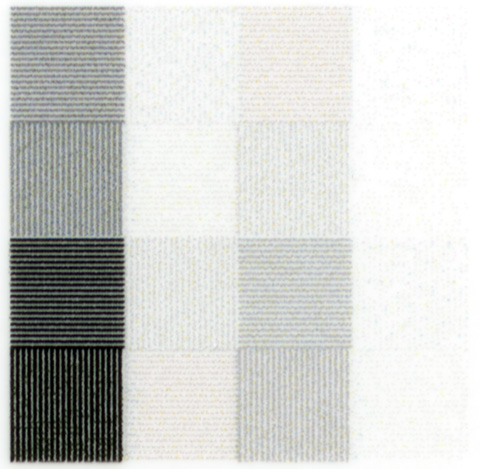
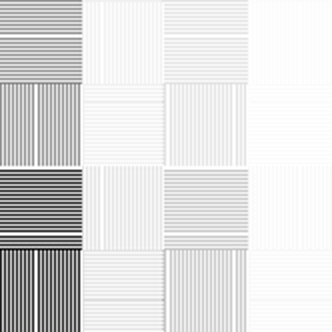
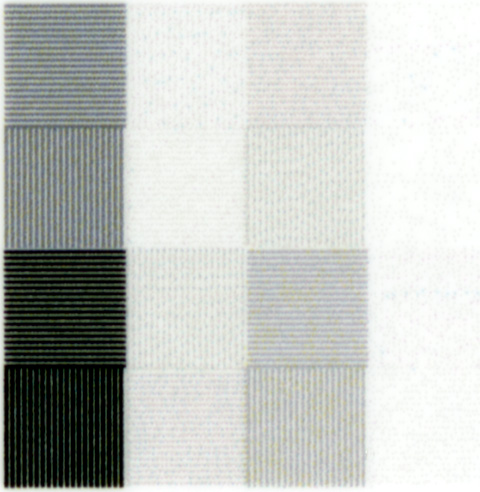
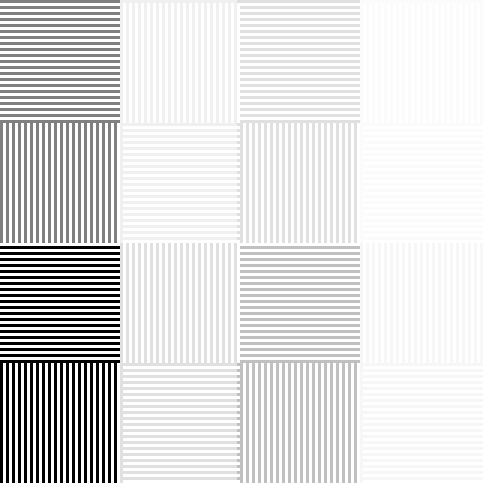
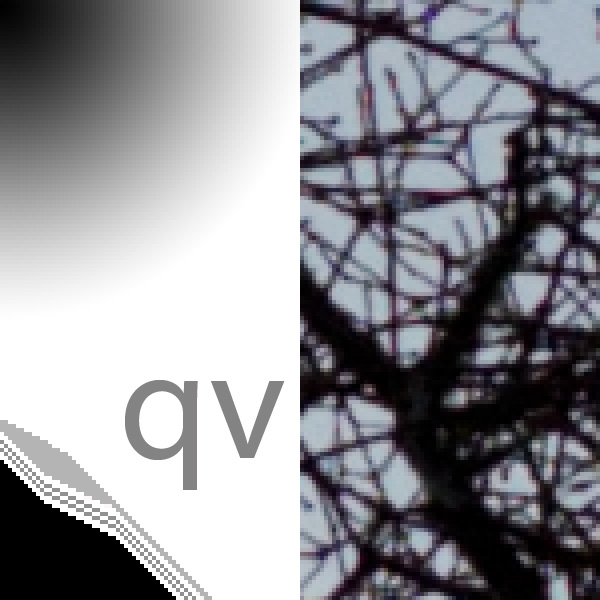
After a couple of false starts, I created the following test image for resampling tests: The test image has a smooth gradient in the upper left corner, a series of lines at two tones and two angles in the lower … Continue reading
Posted in Technical, The Bleeding Edge
1 Comment
Inkjet printing on Epson, part 4
Before moving on to optimum resampling strategies in practice, which is where I’m going with this Epson printer testing, I thought I’d take a look at what happens with the 3880 at 1440/720 dpi resolution. I used ABW mode, and … Continue reading
Posted in Technical
9 Comments
Inkjet printing on Epson, part 3
I thought I’d look at the way the Epson 3880 and the driver resample images at 2880/1440 dpi. I took the now-familiar grating at 700 ppi, and resampled it in Photoshop using nearest neighbor. This is what I got: Then … Continue reading
Posted in Technical
Leave a comment
Inkjet printing on Epson, part 2
I thought I’d compare the Epson driver’s color mode to the Advanced B&W (ABW) mode that I used in yesterday’s post. Here is the test grating at 360 ppi, printed at 2880/1440 dpi: Except for some color shifts that vary with gray … Continue reading
Posted in Technical
Leave a comment
Inkjet printing on Epson, part 1
I’ve had some e-mail correspondence that suggests something about the Epson inkjet hardware and software: That Epson has, in my words, dumbed down the traditional error diffusion dither algorithm so that it can’t represent detail finer than 720 pixels per … Continue reading
Posted in Technical, The Last Word
Leave a comment
Focusing, part 1
If you’ve read the last four or five posts, it’s probably occurred to you that, in the new high resolution digital image, focusing is a challenge. Indeed; if you want to take full advantage of all the pixels that modern … Continue reading
Posted in Technical
3 Comments
Resampling – the mailbag
I got some perceptive comments about the resampling post, all from the same person. Here’s the first: For starters, two-thirds (not half) of the information in any color image from a Bayer-pattern sensor is fabricated. Half of the green and … Continue reading
Posted in Technical
Leave a comment
Resampling
Resampling has a bad name among many photographers. Here’s a typical pronouncement, from here: “I am not going to address resampling here because it degrades an image and has little application in fine art photography. (Resampling is when Photoshop adds … Continue reading
Posted in Technical
Leave a comment
Output antialiasing
Let’s review conventional sampling theory. We start with a continuous representation (the real world, as imaged by the lens), filter that to remove spectral components above half the sampling frequency, sample at evenly spaced infinitesimal points, digitize the results, and … Continue reading
Posted in Technical
Leave a comment
Diffraction, DOF, and digitization in ideal lenses
In response to some e-mail comments about my anti aliasing posts, I’ve been thinking about diffraction, and how it affects format selection. In order to clarify my thinking, I prepared the following spreadsheet: In the first column is the f/ … Continue reading
Posted in Technical, The Last Word
Leave a comment