• site home
  • blog home
  • galleries
  • contact
  • underwater
  • the bleeding edge

the last word

Photography meets digital computer technology. Photography wins -- most of the time.

You are here: Home / The Last Word / More Firehouse pictures

More Firehouse pictures

June 13, 2014 JimK 2 Comments

I’ve been working with a couple of new — to me — fire engines. These are quite different from the old warrior that I started out with, in that they are lovingly restored. The first pictures were in large part about the scars the equipment had gathered over the years. I was initially disappointed that the new ones were so pristine, but it’s turned out great. The images are quite different, though. I’m not sure I’ll be able to exhibit the two sets together.

However, the wonderful thing about working with new material is not knowing where the work is going. If I’m patient and keep at it, it will tell me.

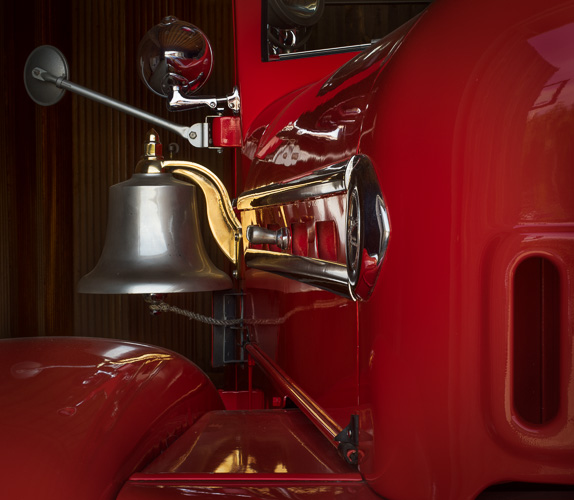
14-05-30_125952_M=B_R=8_S=4-Edit

14-05-30_122508_M=B_R=8_S=4-Edit

14-05-30_123415_M=B_R=8_S=4

All of the images were made with the Zeiss 55mm f/1.4 Otus, the Sony a7R, and a neutral density filter to allow me to use shutter speeds of around 2 seconds,. That’s long enough that the a7R’s shutter vibration is not a problem. Focus stacked with Zerene Stacker or Helicon Focus.

The Last Word

← Back to Timescapes Closer firehouse pictures →

Comments

  1. John says

    August 29, 2018 at 7:45 am

    Hi I understand helicon focus won’t work on Sony I have the R11 would love to get the focus ring if it works regards John

    Reply
    • JimK says

      August 29, 2018 at 8:05 am

      Helicon Focus, the stacking software, works find with Sony files after they’ve been converted to TIFFs. Are you talking about the Helicon FB Tube?

      Reply

Leave a Reply Cancel reply

Your email address will not be published. Required fields are marked *

December 2025
S M T W T F S
 123456
78910111213
14151617181920
21222324252627
28293031  
« Nov    

Articles

  • About
    • Patents and papers about color
    • Who am I?
  • How to…
    • Backing up photographic images
    • How to change email providers
    • How to shoot slanted edge images for me
  • Lens screening testing
    • Equipment and Software
    • Examples
      • Bad and OK 200-600 at 600
      • Excellent 180-400 zoom
      • Fair 14-30mm zoom
      • Good 100-200 mm MF zoom
      • Good 100-400 zoom
      • Good 100mm lens on P1 P45+
      • Good 120mm MF lens
      • Good 18mm FF lens
      • Good 24-105 mm FF lens
      • Good 24-70 FF zoom
      • Good 35 mm FF lens
      • Good 35-70 MF lens
      • Good 60 mm lens on IQ3-100
      • Good 63 mm MF lens
      • Good 65 mm FF lens
      • Good 85 mm FF lens
      • Good and bad 25mm FF lenses
      • Good zoom at 24 mm
      • Marginal 18mm lens
      • Marginal 35mm FF lens
      • Mildly problematic 55 mm FF lens
      • OK 16-35mm zoom
      • OK 60mm lens on P1 P45+
      • OK Sony 600mm f/4
      • Pretty good 16-35 FF zoom
      • Pretty good 90mm FF lens
      • Problematic 400 mm FF lens
      • Tilted 20 mm f/1.8 FF lens
      • Tilted 30 mm MF lens
      • Tilted 50 mm FF lens
      • Two 15mm FF lenses
    • Found a problem – now what?
    • Goals for this test
    • Minimum target distances
      • MFT
      • APS-C
      • Full frame
      • Small medium format
    • Printable Siemens Star targets
    • Target size on sensor
      • MFT
      • APS-C
      • Full frame
      • Small medium format
    • Test instructions — postproduction
    • Test instructions — reading the images
    • Test instructions – capture
    • Theory of the test
    • What’s wrong with conventional lens screening?
  • Previsualization heresy
  • Privacy Policy
  • Recommended photographic web sites
  • Using in-camera histograms for ETTR
    • Acknowledgments
    • Why ETTR?
    • Normal in-camera histograms
    • Image processing for in-camera histograms
    • Making the in-camera histogram closely represent the raw histogram
    • Shortcuts to UniWB
    • Preparing for monitor-based UniWB
    • A one-step UniWB procedure
    • The math behind the one-step method
    • Iteration using Newton’s Method

Category List

Recent Comments

  • JimK on Why wide-angle lenses stretch the edges of the frame
  • Pieter Kers on Why wide-angle lenses stretch the edges of the frame
  • Stefan Feaux de Lacroix on Fujifilm GFX 100RF inclusive review
  • Lou Jost on Leica 280/4 Apo-Telyt R on GFX 50R in infrared
  • JimK on Why wide-angle lenses stretch the edges of the frame
  • JimK on Why wide-angle lenses stretch the edges of the frame
  • Craig Stocks on Why wide-angle lenses stretch the edges of the frame
  • Tim Wilson on Why wide-angle lenses stretch the edges of the frame
  • Erik Kaffehr on Sharpness and aliasing, one more time
  • Scott on Sharpness and aliasing, one more time

Archives

Copyright © 2025 · Daily Dish Pro On Genesis Framework · WordPress · Log in

Unless otherwise noted, all images copyright Jim Kasson.