• site home
  • blog home
  • galleries
  • contact
  • underwater
  • the bleeding edge

the last word

Photography meets digital computer technology. Photography wins -- most of the time.

You are here: Home / The Last Word / Testing for ETTR, part 5

Testing for ETTR, part 5

December 5, 2012 JimK Leave a Comment

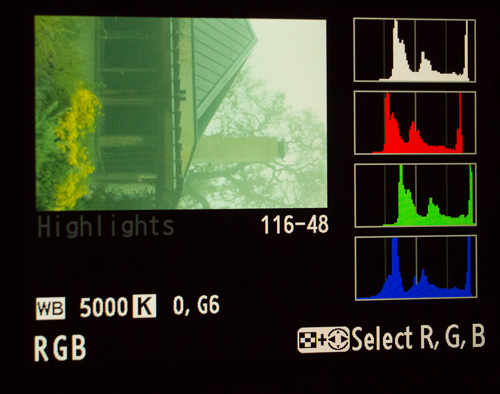
Well, I just spent the whole afternoon on this, but I’ve now got a set of settings for the D4 that give a pretty good approximation to the real raw histogram. The white balance was the problem. Here’s my reasoning; I’m not sure of it yet, but it seems to make sense so far. The sensor has some innate white balance, some color that will excite the three colored photosites equally. I just need to find out about what that is, and set the camera’s manual white balance to it. The preview image will have the wrong white balance, unless the proper white balance for the scene happens to be the camera’s native white balance, which is an unlikely occurrence.

I fiddled around with the manual white balance settings until I zeroed in on a color temperature of 5000 degrees Kelvin and all the green offset available: six steps. I left the contrast set to minimum, the brightness to minimum, and the saturation one click down. In a light rain, I made the following exposure:
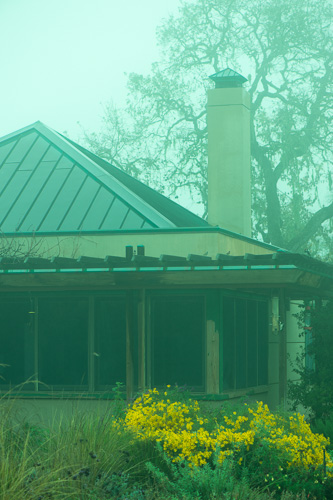
With the in-camera histogram set for ETTR (note the weird green preview image):
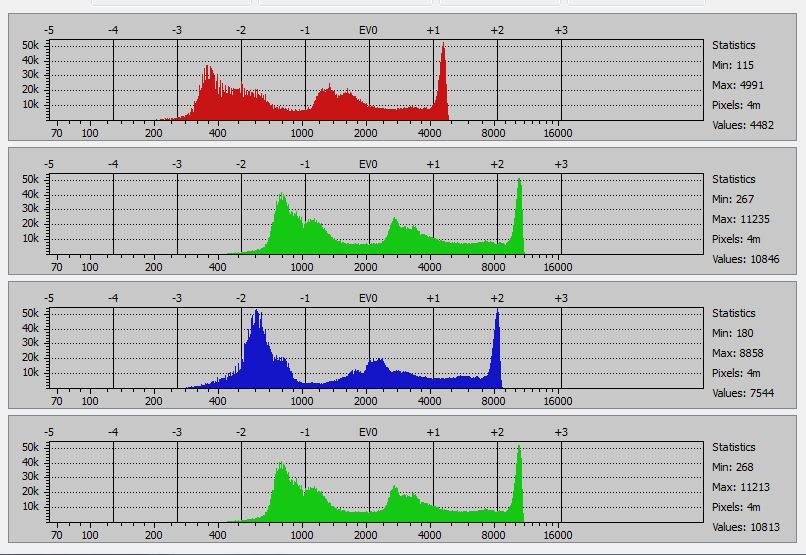
Here’s the real raw histogram:
And here’s the Lightroom histogram with the white balance set to “as shot”:
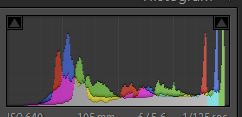
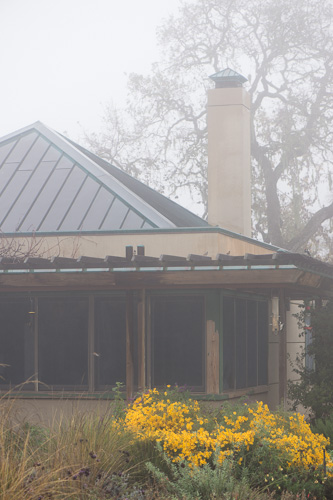
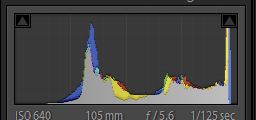
The data in the image is fine in spite of the wonky as shot color balance. Here’s the image with the white balance in Lightroom set to “daylight”:
And here’s the Lightroom histogram with that setting:
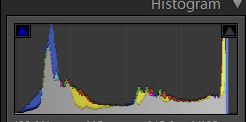
Like any moderate to low contrast image exposed using ETTR (and this was low contrast because of the rain), I needed to correct it with some Lightroom adjustments. Here’s the corrected image:

And here’s its histogram:
The Last Word

← Testing for ETTR, part 4 Testing for ETTR, part 6 →

Leave a Reply Cancel reply

Your email address will not be published. Required fields are marked *

December 2025
S M T W T F S
 123456
78910111213
14151617181920
21222324252627
28293031  
« Nov    

Articles

  • About
    • Patents and papers about color
    • Who am I?
  • How to…
    • Backing up photographic images
    • How to change email providers
    • How to shoot slanted edge images for me
  • Lens screening testing
    • Equipment and Software
    • Examples
      • Bad and OK 200-600 at 600
      • Excellent 180-400 zoom
      • Fair 14-30mm zoom
      • Good 100-200 mm MF zoom
      • Good 100-400 zoom
      • Good 100mm lens on P1 P45+
      • Good 120mm MF lens
      • Good 18mm FF lens
      • Good 24-105 mm FF lens
      • Good 24-70 FF zoom
      • Good 35 mm FF lens
      • Good 35-70 MF lens
      • Good 60 mm lens on IQ3-100
      • Good 63 mm MF lens
      • Good 65 mm FF lens
      • Good 85 mm FF lens
      • Good and bad 25mm FF lenses
      • Good zoom at 24 mm
      • Marginal 18mm lens
      • Marginal 35mm FF lens
      • Mildly problematic 55 mm FF lens
      • OK 16-35mm zoom
      • OK 60mm lens on P1 P45+
      • OK Sony 600mm f/4
      • Pretty good 16-35 FF zoom
      • Pretty good 90mm FF lens
      • Problematic 400 mm FF lens
      • Tilted 20 mm f/1.8 FF lens
      • Tilted 30 mm MF lens
      • Tilted 50 mm FF lens
      • Two 15mm FF lenses
    • Found a problem – now what?
    • Goals for this test
    • Minimum target distances
      • MFT
      • APS-C
      • Full frame
      • Small medium format
    • Printable Siemens Star targets
    • Target size on sensor
      • MFT
      • APS-C
      • Full frame
      • Small medium format
    • Test instructions — postproduction
    • Test instructions — reading the images
    • Test instructions – capture
    • Theory of the test
    • What’s wrong with conventional lens screening?
  • Previsualization heresy
  • Privacy Policy
  • Recommended photographic web sites
  • Using in-camera histograms for ETTR
    • Acknowledgments
    • Why ETTR?
    • Normal in-camera histograms
    • Image processing for in-camera histograms
    • Making the in-camera histogram closely represent the raw histogram
    • Shortcuts to UniWB
    • Preparing for monitor-based UniWB
    • A one-step UniWB procedure
    • The math behind the one-step method
    • Iteration using Newton’s Method

Category List

Recent Comments

  • JimK on Why wide-angle lenses stretch the edges of the frame
  • JimK on Why wide-angle lenses stretch the edges of the frame
  • Craig Stocks on Why wide-angle lenses stretch the edges of the frame
  • Tim Wilson on Why wide-angle lenses stretch the edges of the frame
  • Erik Kaffehr on Sharpness and aliasing, one more time
  • Scott on Sharpness and aliasing, one more time
  • JimK on Price and Performance: Hasselblad X vs. Fujifilm GFX
  • Erik Kaffehr on Price and Performance: Hasselblad X vs. Fujifilm GFX
  • phanter on Averaging captures, precision effects
  • MikaFoxx on ISO setting for raw files

Archives

Copyright © 2025 · Daily Dish Pro On Genesis Framework · WordPress · Log in

Unless otherwise noted, all images copyright Jim Kasson.